

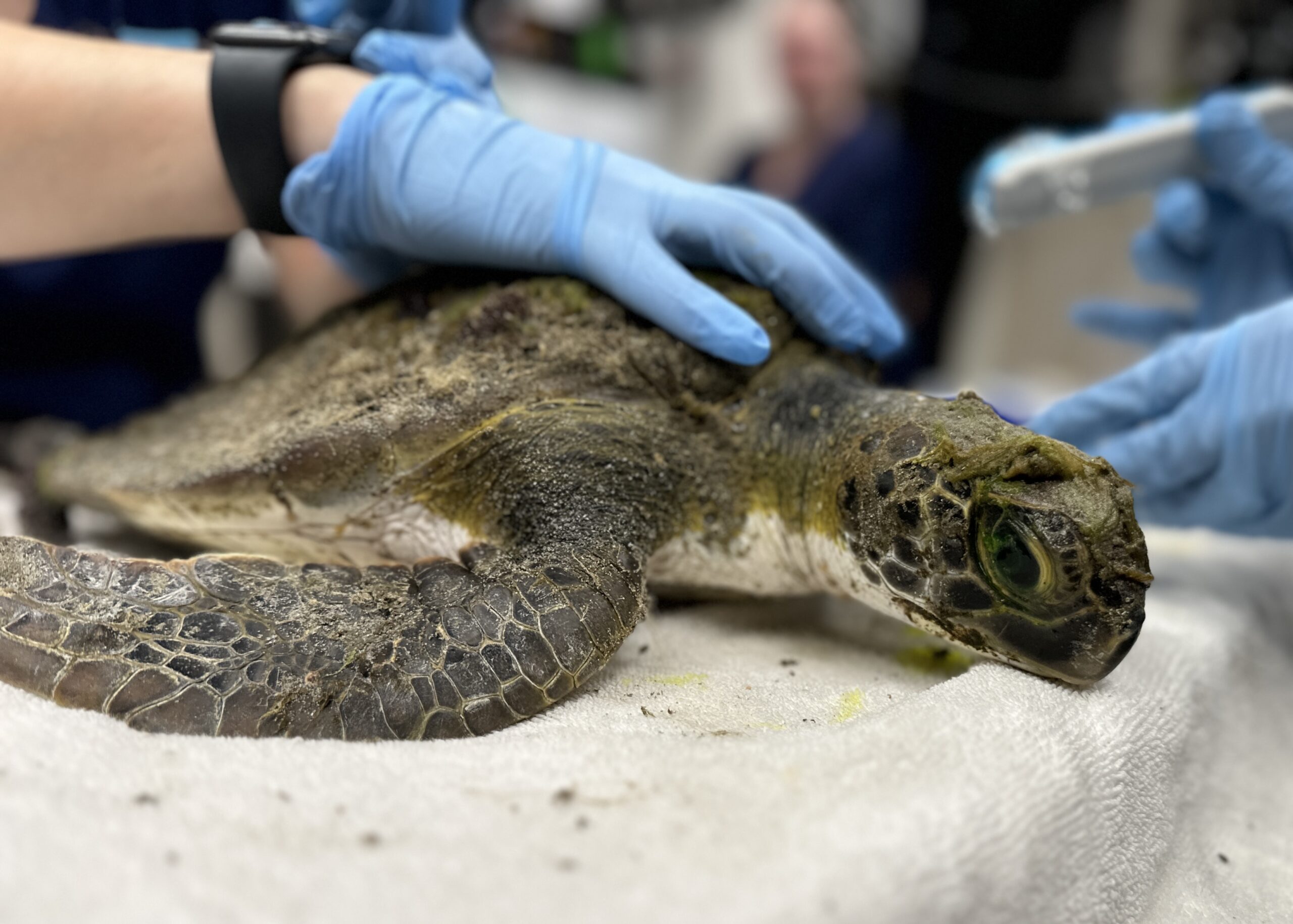
Green (Chelonia mydas)
Stranding Location: North Myrtle Beach, SC
Arrival Date: 4/8/24
Age: Juvenile
Sex: Unknown
Weight: 4.04 kg (8.88 lbs)
Case History
A morning sanitation crew in North Myrtle Beach spotted something in the surf at the beach. As it turns out, this “something” was a little juvenile green sea turtle in distress. The crew called the South Carolina Department of Natural Resources (SCDNR). They deployed permitted members of the North Myrtle Beach turtle team, who made sure that this little green made it to the Aquarium quickly and safely to receive treatment.
Treatment
Upon arrival, it was obvious that this little green had been sick for a while. Staff observed a heavy load of epibiota, like barnacles, algae and skeleton shrimp, on Hashbrown’s carapace (top shell). Initially, Hashbrown had a decent heart rate and was fairly reactive. However, the breaths we saw were not as strong as we would have liked. Based on bloodwork results, the turtle was intubated and given fluids, dextrose (due to low glucose levels), antibiotics, vitamins and other lifesaving medications.
When this little green was more stable, we took diagnostic imaging, like radiographs (x-rays) and a CT scan, to get a better picture as to what may be going on internally. This showed us that there is radio dense material in the gastrointestinal (GI) tract and in the lungs; this is likely sand, but could also be some sort of blockage as we are seeing poor gut motility.
After treatments were completed and Hashbrown had perked back up, we wanted to see if being in water would help her/him even more. Since sea turtles are an aquatic species, they tend to behave more appropriately in water. Hashbrown was placed in a half a tank of water and was initially very active and taking decent breaths. Over time, we saw a decrease in energy levels, so we tried a floating kiddie pool with shallow water. For the safety of Hashbrown though, we decided to wet dock this little green overnight.
Updates
April 11, 2024: Over the last several days, it has been touch and go with Hashbrown. Glucose levels are not maintaining like we had hoped, so each day s/he has received more dextrose and other medications to aid in the recovery process. Hashbrown has graduated from being wet docked to getting some kiddie pool time as well. This little green is making small steps in the right direction but overall, prognosis is very guarded. Please send Hashbrown all of your positive healing vibes!
May 15, 2024: Our first turtle of 2024 has been doing well! Hashbrown is consistently eating well, has been started on vitamins, is defecating often and has been cleared to receive all types of enrichment. We are proud of this little green’s progress! You can now wave to Hashbrown in Zucker Family Sea Turtle Recovery™.
June 15, 2024: Hashbrown has come a long way this month! This active green turtle has finished all medications and is eating great and steadily gaining weight. We recently tagged Hashbrown during an exam and pre-release assessment. While Hashbrown is doing great so far, we’d like to see her/him gain just a bit more weight before release. We will continue to adjust the diet and weigh Hashbrown regularly until we reach that goal!
June 28, 2024: It was an exciting day for this juvenile green sea turtle. After making a full recovery in our Sea Turtle Care Center, Hashbrown was released by boat today into a beautiful local saltmarsh habitat. Wish Hashbrown the best of luck out in the big blue!
May 16, 2025: On Endangered Species Day, we admitted a juvenile green sea turtle who had been struck by a boat and stranded on Daufuskie Island. While triaging this patient, we scanned her/him for a PIT tag, as we do with every sea turtle that we admit into our care. We got a reading and learned that this individual was Hashbrown, our first patient of 2024. Since the boat propeller had struck Hashbrown’s carapace over the spinal cord, we took a CT scan to assess the depth and severity of the wound. The results of the CT scan revealed that this injury had severed Hashbrown’s spine, leaving her/him paralyzed. We were all heartbroken, but knew the best course of action to ease Hashbrown’s pain and suffering was euthanasia.
When we release our sea turtle patients, it is our hope that they get to live long, healthy lives. Despite this tragic event, we were glad to see that Hashbrown had been in good health — growing two inches and gaining two pounds since release last summer— prior to this interaction. This serves as a poignant reminder, especially on Endangered Species Day, that sea turtles face countless dangers out in the wild… many of which are due to humans.
You can help our sea turtle patients after they are released by being a responsible boater. Best practices include respecting no wake zones, using polarized glasses while scanning the water ahead and around you for wildlife and keeping the SCDNR stranding hotline — 1 (800) 922-5431— saved in your phone in the event you encounter a sick or injured sea turtle while you are out on the water.