

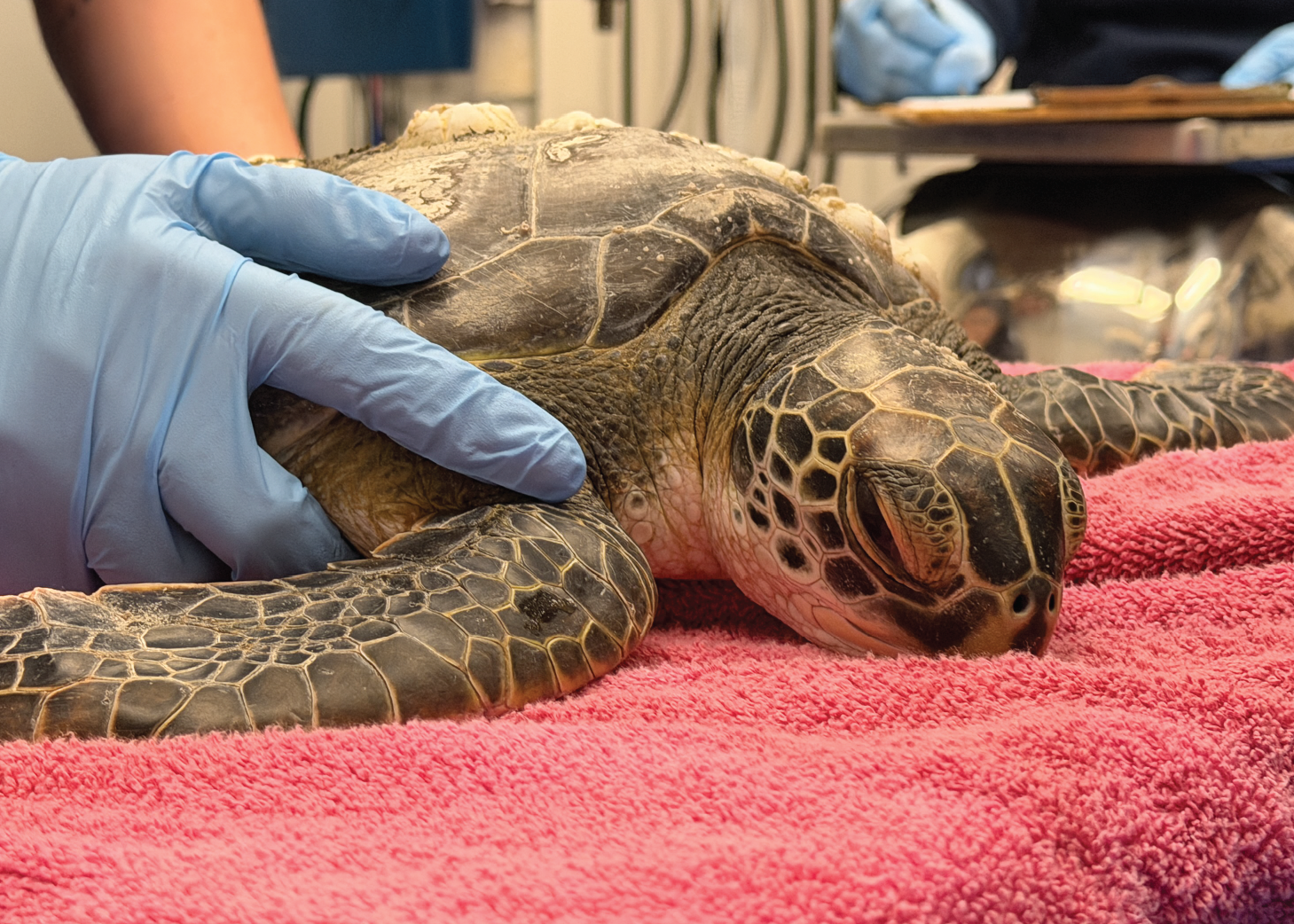
Green (Chelonia mydas)
Stranding Location: Hilton Head Island, SC
Arrival Date: 1/26/26
Age: Juvenile
Sex: Unknown
Weight: 3.91 kg (8.6 lbs)
Case History
A juvenile green sea turtle stranded on Hilton Head Island with an extremely low body temperature. This turtle was swiftly and safely transported to the South Carolina Aquarium for treatment.
Treatment
Upon arrival, this patient was quiet and breathing with minor difficulty. While Ketchup appeared to be in decent body condition, our examination revealed several major issues that meant Ketchup was in critical condition.
The forefront issue for Ketchup was her/his very low body temperature of 45.8 degrees Fahrenheit. Ideally, a sea turtle’s body temperature should be between 70–75 degrees Fahrenheit. With a slow and irregular heart rate and several poor bloodwork values, we decided that this patient needed fluids (to rehydrate and balance bloodwork), dextrose (sugar to stabilize the glucose levels) and much needed rest while slowly warming up.
Normally, we start patients on a course of antibiotics immediately upon admit but Ketchup was so cold that these medications wouldn’t be processed by her/his body until reaching an internal temperature of 65 degrees Fahrenheit. With cold-stunned patients, it is important to warm them slowly so it will take a day or two until Ketchup is ready for more intense medication.
Diagnostic imaging also revealed that Ketchup has a severe case of pneumonia and inhaled sand, which is stuck in the trachea. Since Ketchup is in such critical condition, we chose to place her/him in a dry dock bin overnight to rest. We plan to keep a close eye on Ketchup over the next few days and adjust our treatment plan as s/he warms up and stabilizes.
Updates
January 27, 2026: Although Ketchup was extra quiet overnight, s/he is doing a little bit better this morning. Ketchup’s glucose (blood sugar) levels have slightly improved, her/his heartrate is faster and stronger and s/he is breathing with more ease. However, we still have a long road ahead.
This morning, Ketchup’s body temperature had warmed enough to go into a tank of water. Our tanks on the first floor of the Aquarium are outfitted with the ability to cool to a specific temperature. This is integral to the specialized care that cold-stunned sea turtles need!
Sea turtles with low glucose levels in their blood tire quickly, so we administered fluids and dextrose in the morning and afternoon and placed Ketchup in a shallow kiddie pool anchored in the larger tank. This way, Ketchup can rest in shallow water and does not need to expend as much energy to lift her/his head to breathe.
Ketchup is spending most of her/his time resting now. Once s/he reaches an appropriate body temperature, we will begin antibiotics to battle the pneumonia. This little green sea turtle is still in extremely critical condition and needs all of the help and good wishes you can send!
February 15, 2026: Following Ketchup’s last update, we continued to slowly raise this patient’s internal body temperature to about 75 degrees Fahrenheit. We were then able to begin Ketchup on antibiotics and additional vitamin supplementation. In addition to Ketchup’s pneumonia and being severely dehydrated, s/he also arrived with ulcers in both eyes that we have finished treating successfully. To gain a deeper understanding of Ketchup’s condition, we took a CT scan. These images gave us additional insight into Ketchup’s pneumonia, and revealed that Ketchup was constipated! To help with this, Ketchup received two enemas over the past few weeks which were very successful in moving that fecal material along. We have seen Ketchup perk up with the help of these medical treatments and gain back some energy! Ketchup is now eating and has been moved into deeper water.
March 15, 2026: Ketchup continues to improve each week! Now that Ketchup is on a weighted diet and is eating consistently, we have switched from injectable vitamins to oral vitamins! This, in conjunction with antibiotics and fluids, has been crucial in Ketchup’s improvement. We have noticed a major change in Ketchup’s demeanor recently —when this little green first arrived, s/he was very lethargic but is now much more active and spunky!
April 15, 2026: In the last month Ketchup has made great strides towards recovery! Like many of our newly admitted green sea turtle patients, Ketchup shows a diet preference for fish over veggies. We help encourage Ketchup to finish the veggies by offering them well before the more coveted fish pieces. This approach has paid off well and with several gradual diet increases, Ketchup is now steadily gaining weight! Ketchup has also been interacting with new forms of enrichment and can often be seen scratching her/his carapace on these PVC structures to remove several of the barnacles that remain on her/his shell. We plan to recheck Ketchup’s bloodwork soon, now that s/he has finished an extended antibiotic prescription. If all comes back positive, we hope to tag Ketchup in preparation for release in the future. Fingers crossed for this resilient little green turtle!
May 15, 2026: Last month, Ketchup was PIT tagged — a major milestone for her/him. Unfortunately, her/his right eye became inflamed and swollen. To check up on it, we reached out to our colleague Dr. Anne Cook, a local veterinary ophthalmologist! Dr. Cook confirmed that all internal structures of Ketchup’s eye were in sound condition — meaning there was no visible damage. We followed this exam up with a CT scan, which confirmed her findings. We believe the inflammation may have been caused by Ketchup using an enrichment item too enthusiastically, so we have temporarily removed enrichment from her/his tank and started Ketchup on an anti-inflammatory medication. In addition to limiting access to enrichment within the tank, we have lowered the water level to be sure that Ketchup cannot reach the plumbing that returns water to the tank. We are already seeing improvements in Ketchup’s eye and will continue to monitor it closely!