

Green (Chelonia mydas)
Stranding Location: Kiawah Island, SC
Arrival Date: 5/29/2025
Age: Juvenile
Sex: Unknown
Weight: 2.4 kg (5.28 lbs)
Case History
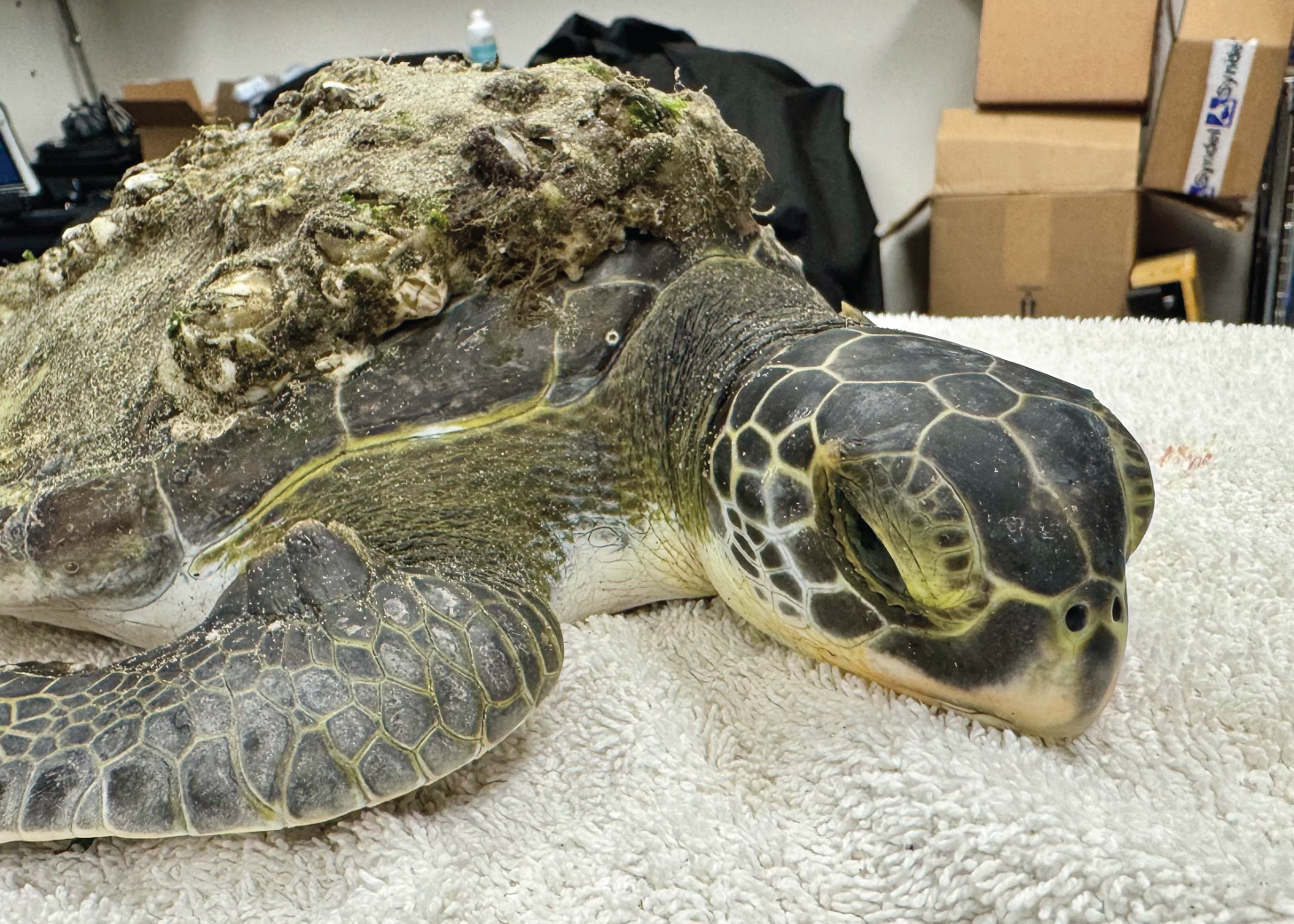
This juvenile green sea turtle was found washed ashore in a tidal pool and was rescued and safely transported to the Aquarium by permitted South Carolina Department of Natural Resources (SCDNR) volunteers. The patient arrived responsive and in decent body condition, but the shell was completely covered in large clusters of barnacles and sand. This indicates that the turtle had been sick and sluggish for an extended period of time.
Treatment
Upon admit, we performed a physical exam and were pleased to see that, despite the heavy epibiota load, this patient’s energy level was good! Bluebonnet was strong and lifting her/his head well to take deep breaths. Other than a few abrasions on the shell and skin, there were no major external injuries. We did find a small corneal ulcer in the right eye which we began treating with ophthalmic drops. Next, we took radiographs, which were slightly difficult to interpret due to the heavy barnacle load on the carapace (back shell). Therefore, we followed up by taking a CT scan to get a clearer image of Bluebonnet’s internal organs. No hooks or signs of foreign material were noted and Bluebonnet’s lungs appeared relatively normal! We did, however, see a large amount of fecal material backed up in Bluebonnet’s gastrointestinal (GI) tract. This is common in patients that have been immunocompromised for a long period of time, which results in slowed or sluggish digestion. Typically, this can be resolved by rehydrating the patient and boosting their immune system. We started Bluebonnet on antibiotics and fluids with vitamins and swim tested her/him in a shallow tank of water to see if there were buoyancy issues. Thankfully, Bluebonnet was able to dive easily and was swimming calmly enough that we felt comfortable leaving her/him in the tank overnight to rest and recover.
Updates
June 1, 2025: Bluebonnet has been making great progress over the past few days! We have begun offering small amounts of fish and veggies daily and Bluebonnet has a great appetite so far! This will help this little green regain the strength and energy needed to heal. We are also glad to see that digesta is beginning to move through the GI tract, reassuring us that there is not a blockage. We will begin increasing the depth of the water in the tank as Bluebonnet’s energy improves.
July 15, 2025: When our patients begin to defecate after admit, we test a fecal sample from them once a week for three weeks. These tests reveal the presence of parasites and can show us how well the GI tract is working. In Bluebonnet’s case, these tests indicated that Bluebonnet has a GI parasite called caryospora. Because of this, Bluebonnet is under a quarantine protocol so this parasite does not spread to our other patients. Luckily, caryospora has not affected Bluebonnet’s appetite, so s/he is still eating well and defecating regularly. This is extra helpful in getting her/him to take the oral medication to mitigate the parasitic presence. In the past month, Bluebonnet has gained energy and is now in full tank of water!
July 30, 2025: Bluebonnet was released into the protected saltmarsh alongside Hibiscus, Iris, Orchid and Tulip! Good luck out in the big blue!